Posts

Showing posts with the label 2017

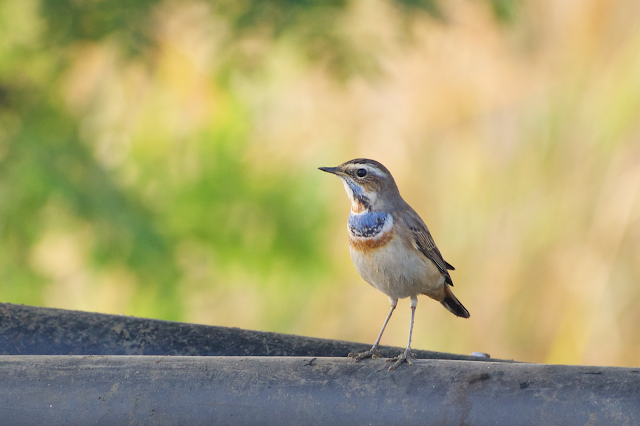
Birds Around Me 0058 - Bluethroat (नीलकण्ठी पिद्दा) - Cyanecula svecica
Image
It was an early winter morning in Jabalpur, Madhya Pradesh. I set out with my camera kit, camouflaged in military green, ready for another day of birding. Just then, the milkman on his daily round stopped, curiosity written all over his face. He bombarded me with questions—where was I going so early, what was I doing with such a big camera, whether I worked for a newspaper or television, and how much I got paid for this “job.” Finally, with a chuckle, he concluded that I had far too much free time. Before leaving, he invited me to his farm, promising I could photograph “loads of birds” there, and gave me directions.   Bluethroat (नीलकण्ठी पिद्दा) - Cyanecula svecica  Sanjivini Nagar, Jabalpur His farm happened to be along my usual route, so I decided I’d stop by on my way back. At the very least, I thought, I could buy the fresh butter he always boasted about. After a two-hour walk, I reluctantly went to his farm. To my surprise, he greeted me with great excitement, intro...
Birds Around Me 0028 - Indian Rose-ringed Parakeet (तोता) - Psittacula krameri manillensis

Image
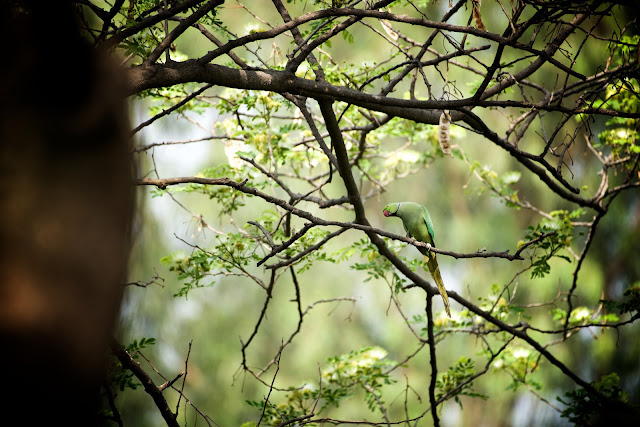
Indian Rose-ringed Parakeet (तोता) - Psittacula krameri manillensis  Indian Rose-ringed Parakeet (तोता) - Psittacula krameri manillensis  (42 cm), is the most common and widespread parakeet throughout most of the Indian sub-continent. Males can be distinguished by black and rose collars, which are absent in females.  They are the UK's only naturalized Parrot, found in large numbers in parks all around London.  Indian Rose-ringed Parakeet (तोता) - Psittacula krameri manillensis  Bird Facts: It has an excellent ability to mimic human speech and can contextually apply it  depending on the situation; unfortunately, this makes it very popular as a pet throughout the world.   Identification:  slim green with black-rose ring (males)   Where:  wooded habitats, including the vicinity of man, cultivation Hindi Name of Indian Rose-ringed Parakeet (Psittacula krameri manillensis): तोता Birds Around Me - Unfinished List (अपूर्ण  सूची)...

Birds Around Me 0067 - Painted Stork (कठसारंग) - Mycteria leucocephala

Image
Do you know that there are about 20 species of stork and they live upto 30, at time 40 years.  The largest species of stork is the M arabou stork  (Leptoptilos crumenifer) , with a height of 152 centimeters and a wingspan of 3.7 meters (12 feet) largest wing-spread of any living bird. The smallest stork is the  hamerkop  ( Scopus umbretta )  at 56 centimeters (22 inches) in length with a weight of 470 grams (17 ounces). Painted Stork (कठसारंग) - Mycteria leucocephala is a medium sized stork and can be seen all across India. I have seen them in Delhi, Jabalpur and Bangalore. First time I was them was in a nest on top of a tree by the road side and the size of bird and its nest amazed me. Painted Stork (कठसारंग) - Mycteria leucocephala Padariya, Jabalpur, October 2023 Painted Stork (कठसारंग) - Mycteria leucocephala  medium-sized (93 cm), is large stork has a heavy yellow beak with a down-curved tip. The head of the adult is bare and orange or reddish in col...

Birds Around Me 0025 - Common Myna (देसी मैना, गुलगुल) - Acridotheres tristis

Image
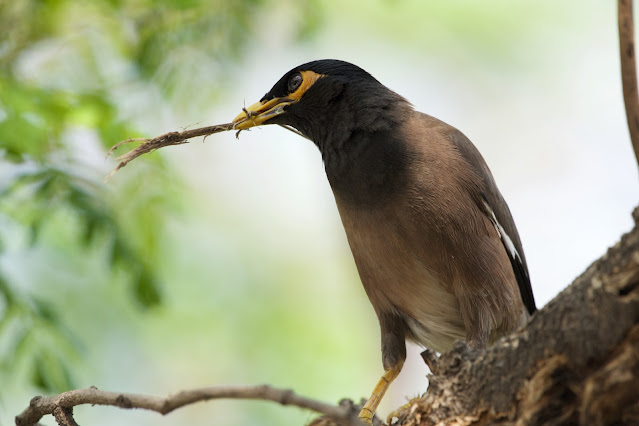
The Common Myna (देसी मैना, गुलगुल) - Acridotheres tristis is readily identified by the brown body, black hooded head, and the bare yellow patch behind the eye. The bill and legs are bright yellow. There is a white patch on the outer primaries and the wing lining on the underside is white. The sexes are similar and birds are usually seen in pairs. Along with the sparrow, crow, and pigeon, Myna is comfortable around humans. A pair or two will usually adopt a house as their own and defend it vigorously against intrusion from others of their kind. But large numbers will collect to feed in harmony whether on earthworms on a freshly watered lawn, winged termites emerging from the rain-sodden ground, or on a fig-laden banyan or peepal tree. The birds commonly attend on grazing cattle for crickets and grasshoppers disturbed by animals' feet or follow the plow for the worms and grubs turned up with the soil, stalking jauntily alongside the bullocks, now side-hopping, now springing up in th...